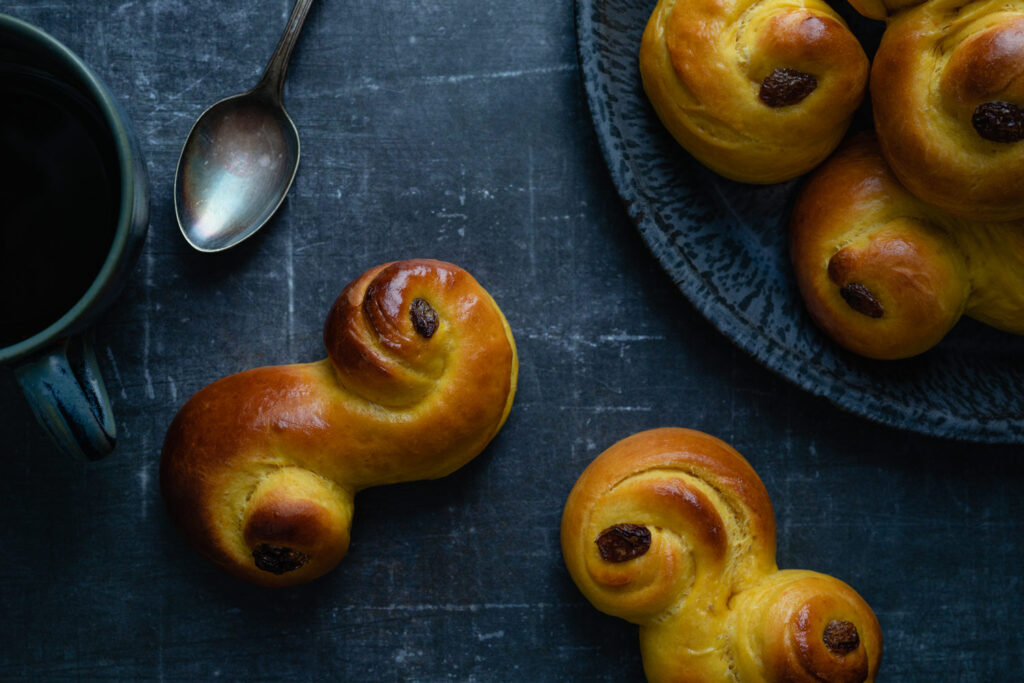
Lussekatter are saffron sweet buns traditionally made for St. Lucia Day on December 13 in Sweden and Norway. St. Lucia Day in Scandinavia is a celebration of light at the darkest time of year and marks the beginning of the Christmas season.

Before the adoption of the modern calendar, December 13 was recognized in Scandinavia as the shortest day and longest night of the year. The holiday celebrates the story of Saint Lucia who attached candles to a wreath on her head in order to provide light while carrying supplies to persecuted Christians hiding in the dark catacombs of Rome under Diocletian in 285.
Nowadays, festivals are held throughout Scandinavia with one girl portraying St. Lucia in a white dress and a crown of candles. She leads a procession of children in white robes holding candles to bring light into the darkness.
Lussekatter, or saffransbullar are soft, slightly sweet, and a beautiful golden hue. They’re perfect for breakfast with a steaming mug of coffee, or as a snack alongside a cup of cozy glögg.
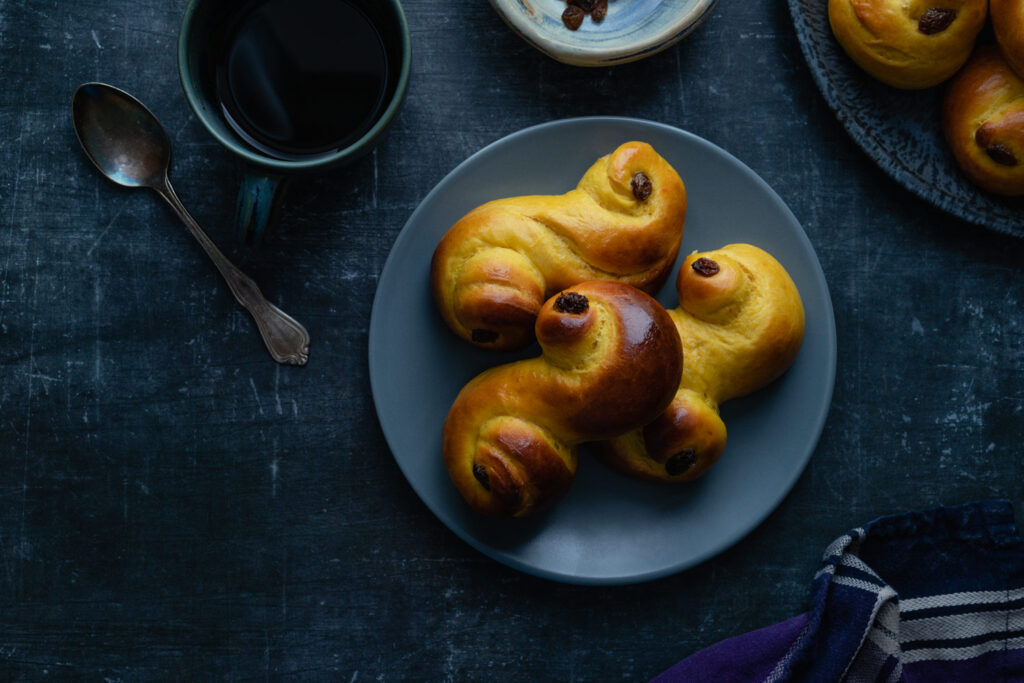
Yields 15 saffron buns.
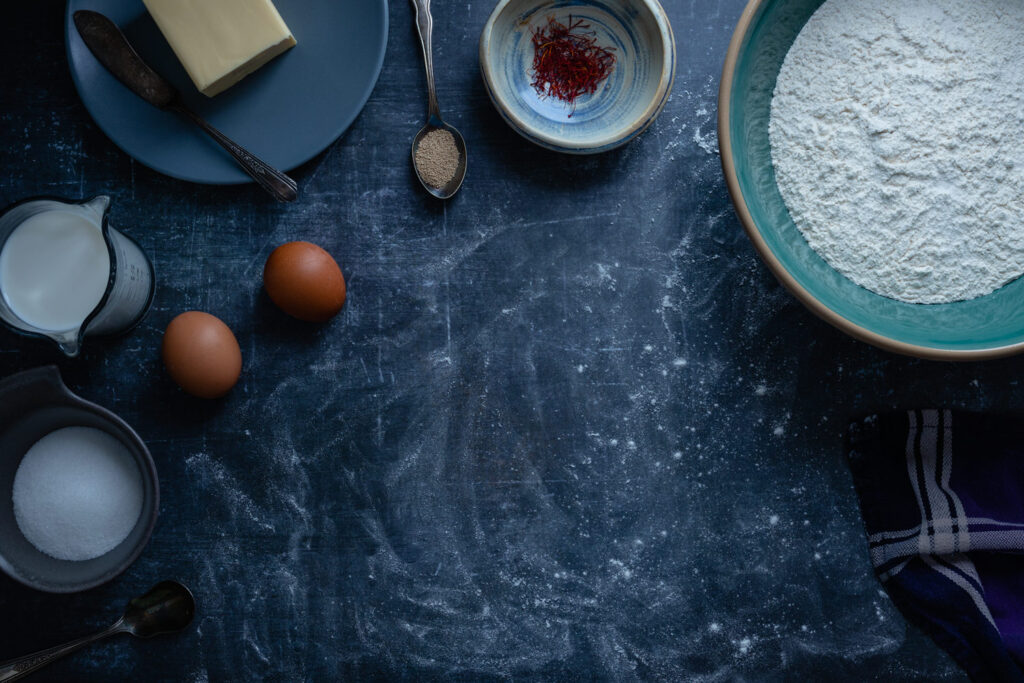
Steep the saffron:
Use a mortar and pestle, or the back of a spoon, to grind the saffron into a powder.
Heat half of the milk (150ml) and the butter in a small saucepan on medium heat until the butter is melted and the mixture just begins to simmer.
Take the pot off the heat and add the saffron. Set aside and let the mixture steep until lukewarm.
Proof the yeast:
Heat the remaining milk (150ml) to 46°C (115°F). Add the yeast to the warm milk and let it bloom for 5 to 10 minutes, until it begins to foam.
Combine the dry ingredients:
In the bowl of a stand mixer, or in a large mixing bowl, whisk together the bread flour, sugar, and salt.
Mix the dough:
Make a well in the center of the dry ingredients and pour in both milk mixtures and the beaten eggs.
If using a stand mixer, attach the dough hook and knead the dough until it is smooth and elastic, approximately 6 minutes.
If mixing by hand, stir the mixture with a rubber spatula until it comes together. Scrape the dough out onto a lightly floured surface and knead by hand until smooth and elastic, about 10 minutes. The dough will be sticky at first, but try not to add much flour.
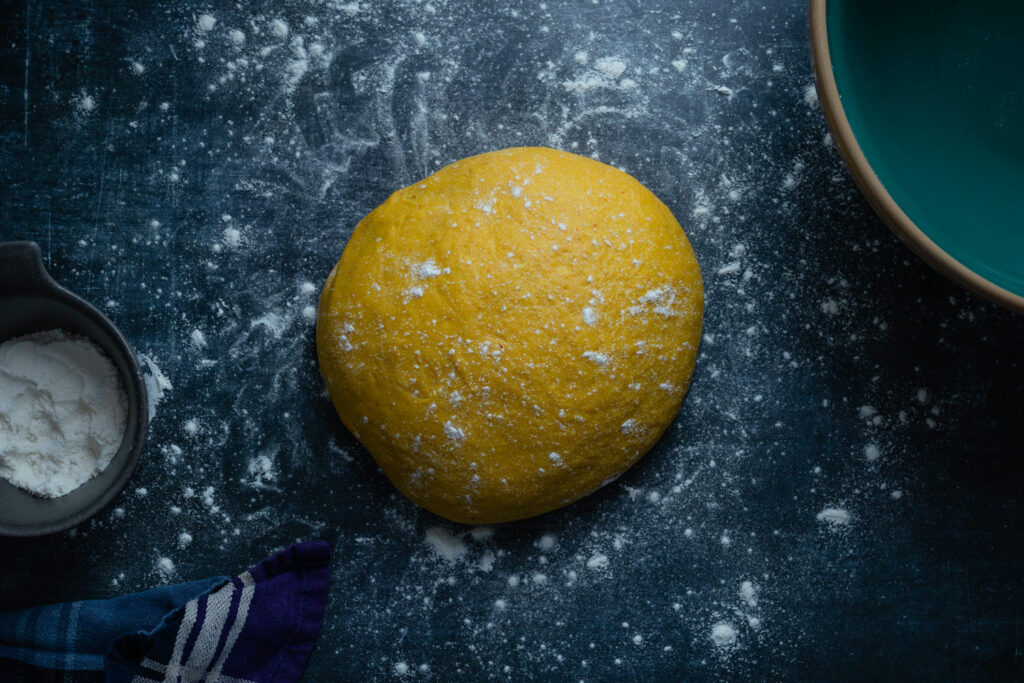
Let the dough rise:
Transfer the dough to a lightly oiled bowl and cover with a damp tea towel or a sheet of plastic wrap. Let the dough rise until doubled in size, about 1 hour.
Shape the saffron buns:
Divide the dough into 15 equal pieces. Working one at a time, use your palms to roll out each piece into a 12-inch (30cm) rope. Curl up one end into a spiral down to the middle of the strand. Spiral the other end of the strand in the opposite direction, forming an ’S’ shaped bun.
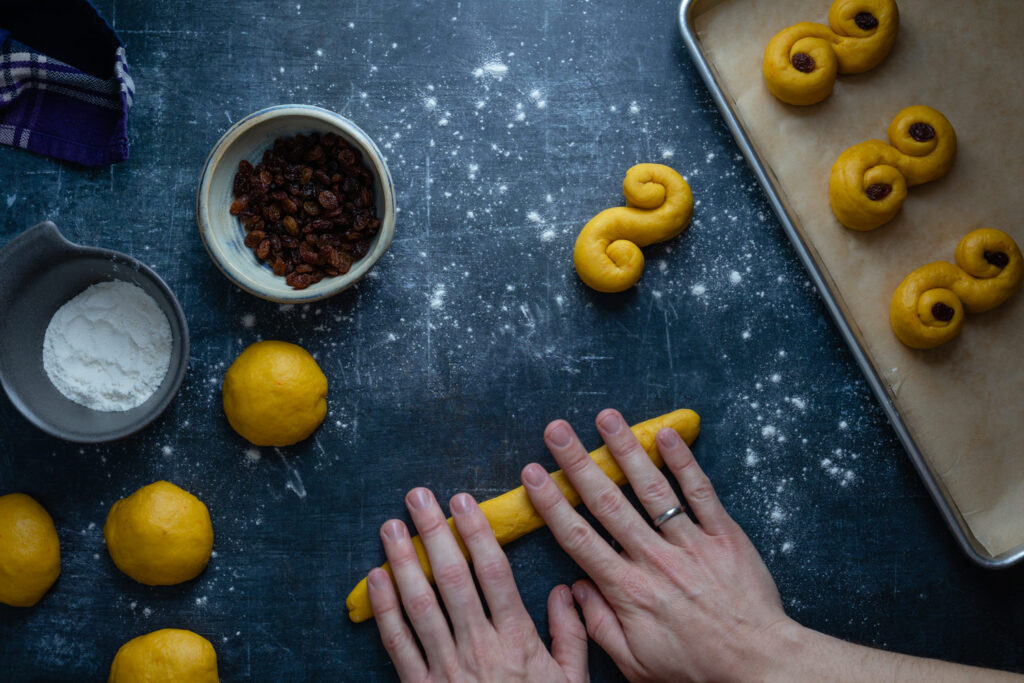
Transfer the shaped buns onto a large parchment lined baking tray, or 2 smaller trays. Cover loosely with a damp tea towel or plastic and let them prove until almost doubled in size, about 30 minutes.
Alternatively, you can have them prove overnight in the refrigerator and bake them the next morning.
Bake:
Preheat the oven to 200°C (400°F).
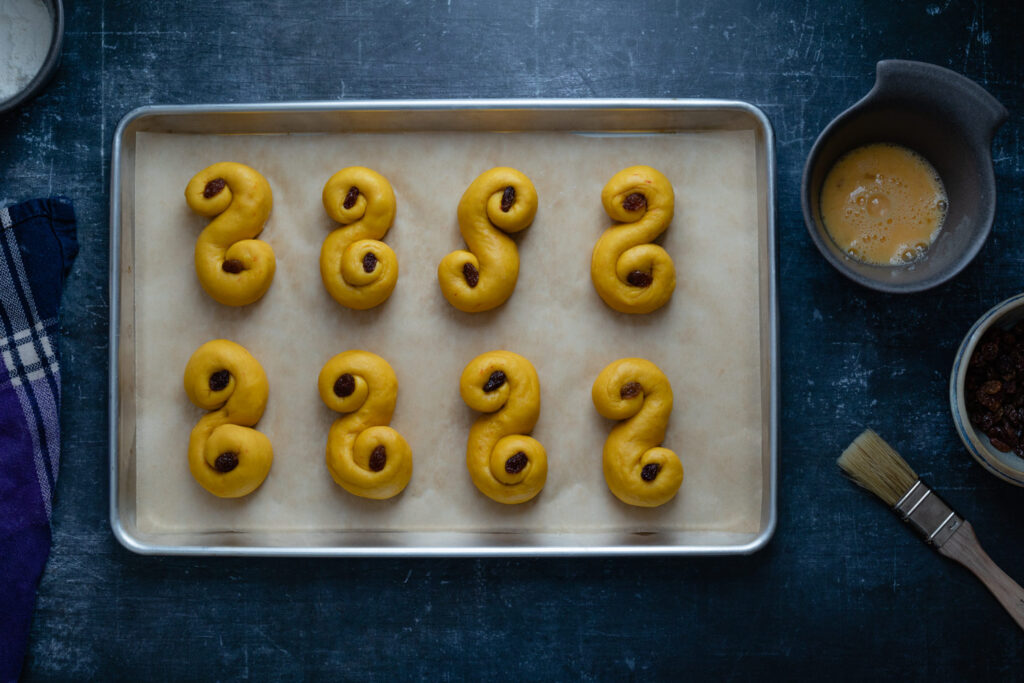
Brush each bun with the beaten egg and push a raisin into the center of each spiral.
Bake the buns until golden brown, about 10 to 12 minutes.

Lussekatter: Swedish Saffron Buns
Lussekatter, or saffransbullar are soft, slightly sweet, and a beautiful golden hue. They’re perfect for breakfast with a steaming mug of coffee, or as a snack alongside a cup of cozy glögg.
Ingredients
- 300 ml whole milk divided
- 100 g unsalted butter
- 0.5 g saffron
- 7 g active dry yeast 1 packet
- 600 g bread flour
- 100 g granulated sugar
- 1 tsp salt
- 2 large eggs beaten
- 1 egg for egg wash
- 30 raisins for decorating
Instructions
- Grind the saffron
Use a mortar and pestle, or the back of a spoon, to grind the saffron into a powder.
- Steep the saffron
Heat half of the milk (150 ml) and the butter in a small saucepan on medium heat until the butter is melted and the mixture just begins to simmer.
Take the pot off the heat and add the saffron. Set aside and let the mixture steep until lukewarm.
- Proof the yeast
Heat the remaining milk (150ml) to 46°C (115°F). Add the yeast to the warm milk and let it bloom for 5 to 10 minutes, until it begins to foam.
- Combine the dry ingredients
In the bowl of a stand mixer, or in a large mixing bowl, whisk together the bread flour, sugar, and salt.
- Add the wet ingredients
Make a well in the center of the dry ingredients and pour in both milk mixtures and the beaten eggs.
- Knead the dough
If using a stand mixer, attach the dough hook and knead the dough until it is smooth and elastic, approximately 6 minutes.
If mixing by hand, stir the mixture with a rubber spatula until it comes together. Scrape the dough out onto a lightly floured surface and knead by hand until smooth and elastic, about 10 minutes. The dough will be sticky at first, but try not to add much flour.
- Let the dough rise
Transfer the dough to a lightly oiled bowl and cover with a damp tea towel or a sheet of plastic wrap. Let the dough rise until doubled in size, about 1 hour.
- Shape the buns
Divide the dough into 15 equal pieces. Working one at a time, use your palms to roll out each piece into a 12-inch (30 cm) rope. Curl up one end into a spiral down to the middle of the strand. Spiral the other end of the strand in the opposite direction, forming an ‘S’ shaped bun.
- Prove the buns
Transfer the shaped buns onto a large parchment-lined baking tray, or 2 smaller trays. Cover loosely with a damp tea towel or plastic and let them prove until almost doubled in size, about 30 minutes.
Alternatively, you can have them prove overnight in the refrigerator and bake them the next morning.
- Bake
Preheat the oven to 200°C (400°F).
Brush each bun with the beaten egg and push a raisin into the center of each spiral.
Bake the buns until golden brown, about 10 to 12 minutes.

Leave a Reply